
Why Everyone Visiting Southern Africa Skips the Midlands Meander (And Why That’s a Mistake)
You’ve heard of the Garden Route. You’ve seen the photos of the Drakensberg. You’ve probably already got Kruger on your list. But if you’re planning a trip through South Africa and you haven’t heard of the Midlands Meander, you’re missing one of the country’s most rewarding detours.
The Midlands Meander is a network of country roads winding through the KwaZulu-Natal Midlands, roughly an hour’s drive from Pietermaritzburg and under two hours from Durban. It stretches across rolling green hills, dairy farms, forests, and quiet valleys, linking together more than 200 stops — artists’ studios, cheeseries, craft breweries, guest farms, restaurants, and nature reserves — into a self-drive route you can tackle in a weekend or stretch across a full week.
It’s the kind of place that doesn’t shout. There are no cable cars, no floodlit viewpoints, no bus parks full of tour groups. But that’s precisely the point.
What Makes the Midlands Meander Different
Most Southern African travel routes are built around a single destination — a park, a canyon, a beach. The Midlands Meander is built around a way of travelling. It’s about slowing down, stopping where you feel like stopping, and discovering things that don’t appear on any top-10 list.
The route was started in 1985 by a handful of local artists and craftspeople who wanted to create a trail that connected their studios. Nearly four decades later, it’s grown into one of South Africa’s most established arts and crafts routes, but it still feels personal. Many of the stops are family-run operations that have been there for generations. The cheese at Fairmont has been made the same way for decades. The pottery at Terracroft is still thrown by hand. The beer at Nottingham Road Brewery is still brewed in a converted old dairy.
This is slow travel, South African style. And in spring (September to November), when the hills are green, the wildflowers are out, and the summer heat hasn’t arrived yet, it’s at its absolute best.
How to Plan Your Midlands Meander
You don’t need a strict itinerary. That’s the beauty of it. But here’s how to think about it.
Base yourself somewhere central. The villages of Nottingham Road, Mooi River, and Howick are all good jumping-off points. You’ll find everything from self-catering cottages on working farms to boutique country lodges with fireplaces and full English breakfasts. In spring, the mornings are crisp and the evenings call for a red wine by the fire — pack layers.
Allow at least two full days. One day isn’t enough. The roads are slow, the stops are many, and the temptation to linger is constant. Two days gives you a relaxed loop without rushing. Three or four lets you go deeper — hiking trails, waterfalls, and the quiet back roads that most visitors never find.
Drive, don’t bus. Public transport doesn’t exist in any meaningful way here. You’ll need a car. The roads are good (mostly tarred, some gravel) and the distances between stops are short — usually 10 to 20 minutes. A standard sedan is fine for most of the route.
The Stops You Shouldn’t Miss
Howick Falls and the Karkloof
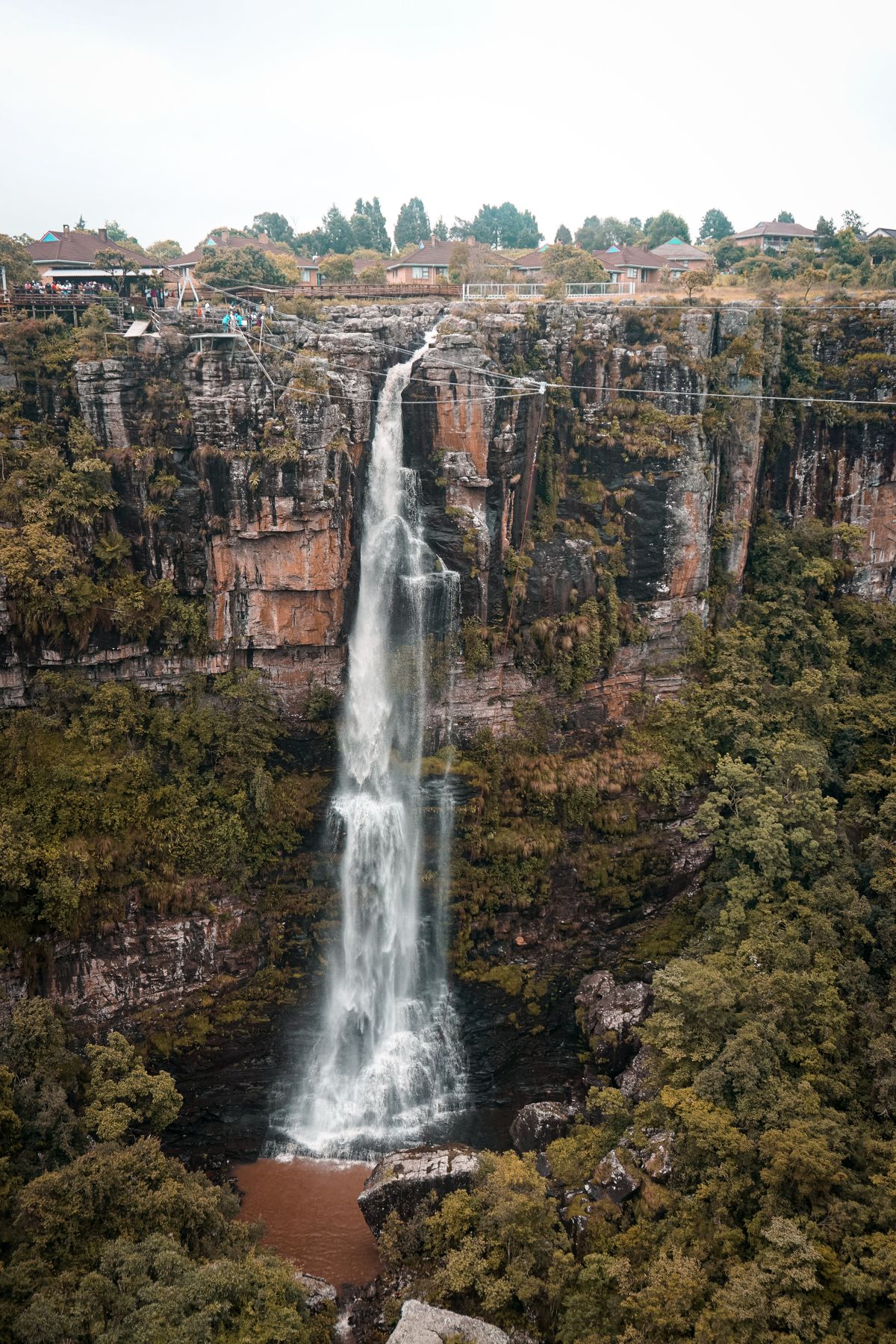
Start at Howick, where the Umgeni River plunges 95 metres into a forested gorge. Howick Falls is one of those rare waterfalls that’s easy to reach (you can see it from a viewing platform near the town centre) and genuinely spectacular. From there, head into the Karkloof Nature Reserve, where you’ll find indigenous forest, hiking trails, and a canopy tour that takes you ziplining through the trees. If you’re lucky, you might spot a crowned eagle or one of the reserve’s small herds of reedbuck.
Nottingham Road and the Craft Beer Country
Nottingham Road is the unofficial capital of the Meander. It’s a tiny village with a pub (the Notties Hotel, established in 1854 and still serving), a brewery, a cheese shop, and a few restaurants and craft stores. The Nottingham Road Brewery is worth a stop — their Pye Pie ale has something of a cult following, and the brewery itself is housed in an old dairy that still smells faintly of hay. Around the corner, you’ll find Rawdons, a hotel and pub with a slightly faded colonial charm that’s worth a pint if only for the atmosphere.
The Cheeseries and Farm Stalls
The Midlands is dairy country, and the cheeseries are a highlight. Cambridge Cheese, Fairmaide Cheese, and Swissland Cheese all offer tastings and sell direct from the farm. You can watch the cheese being made, taste it at different ages, and buy wedges to take with you. Pair it with a stop at one of the farm stalls — Piggly Wiggly is the most famous, a slightly quirky collection of shops and restaurants built around a central courtyard with a children’s play area and a miniature train.
Art, Craft, and the Studios
The Meander’s artistic roots are still visible. There are pottery studios (Terracroft, Bovas), weavers, woodworkers, and painters dotted along the route. Many welcome visitors into their workshops. You can watch a potter throw a vase, browse a gallery in a converted barn, or commission a piece. Prices are reasonable, and you’re buying directly from the maker.
Practical Tips for the Midlands Meander
When to go: September to November (spring) and March to May (autumn) are the best windows. Summer (December to February) is lush but wet — afternoon thunderstorms are common and some gravel roads can become tricky. Winter (June to August) is beautiful but cold, with frost on the hills and the occasional snow on the high ground.
What to budget: Less than you’d think. Self-catering cottages start at around R800 per night. A decent country lodge with breakfast will cost R1,200 to R2,000. Meals at the pubs and restaurants are reasonable — expect R120 to R250 for a main course. Many of the craft stops and nature reserves are free or charge a small conservation fee.
What to bring: Walking shoes for the trails, a warm layer for the evenings, a cooler bag for cheese and beer purchases, and a paper map. Cell signal is patchy in places, and the Meander map (available at most stops) is more reliable than Google Maps for finding the smaller studios.
How to get there: From Durban, take the N3 northwest — about 90 minutes to Howick. From Johannesburg, it’s a 5-hour drive. From the Drakensberg, you can reach the western end of the Meander in under an hour, making it an easy add-on to a Berg trip.
The Real Reason to Go
The Midlands Meander won’t give you a Big Five sighting or a selfie at a world-famous landmark. What it will give you is something that’s increasingly rare in Southern African travel: a sense of place. The kind of place where the woman selling the cheese also made it. Where the artist whose painting you bought is the one who poured your coffee. Where the road doesn’t lead to a destination — it is the destination.
In a region full of headline attractions, the Midlands Meander is the detour that most travellers never take. And that’s exactly why you should.




The editorial team at Destination Southern Africa brings you the most comprehensive travel intelligence for Southern Africa. With decades of combined experience in African tourism, we cover everything from hidden gems to practical travel tips for international visitors.