
Why the Panorama Route Belongs on Every Southern Africa Itinerary
Most travellers racing from Johannesburg to Kruger National Park blow past Mpumalanga’s Panorama Route in under an hour. They’re chasing the Big Five. Fair enough. But in doing so, they miss one of the most dramatically beautiful stretches of road in the entire African continent.
The Panorama Route runs roughly 150 kilometres along the escarpment of the Drakensberg, where the highveld drops away into the lowveld below. It’s a landscape of deep gorges, plunging waterfalls, ancient caves and viewpoints that will make you pull over every ten minutes. October can be a rewarding time to visit, though rainfall, visibility and waterfall flow vary with the season and recent weather.
If you’re planning a trip to Kruger or the greater Kruger region, budget at least one full day for the Panorama Route. Here’s what you need to know.
The Highlights: Where to Stop and What You’ll See
God’s Window: The name is not marketing. On a clear day the views stretch across the Lowveld far below. The view stretches across the endless lowveld, and the drop is sheer enough to make anyone with mild vertigo think twice about the railing. There are two viewing points here , most tourists stop at the first, which means the second is often quieter. Walk the extra 200 metres. It’s worth it.
Bourke’s Luck Potholes: Where the Treur and Blyde rivers meet, centuries of water erosion have carved cylindrical potholes into the bedrock. The result is a strange, almost alien landscape of swirling rock formations. There’s a small entrance fee and a network of bridges and walkways that let you get right down into the gorge. Allow 30 to 45 minutes.
Blyde River Canyon: A vast, lush canyon known for its dramatic scenery. Unlike the Fish River Canyon or the Grand Canyon, Blyde is lush, subtropical and alive. The best viewpoint is the Three Rondavels, three massive rock formations shaped like traditional African huts. Stand here at golden hour and the rock glows red against the green valley. It’s one of the most photographed scenes in Southern Africa for good reason.
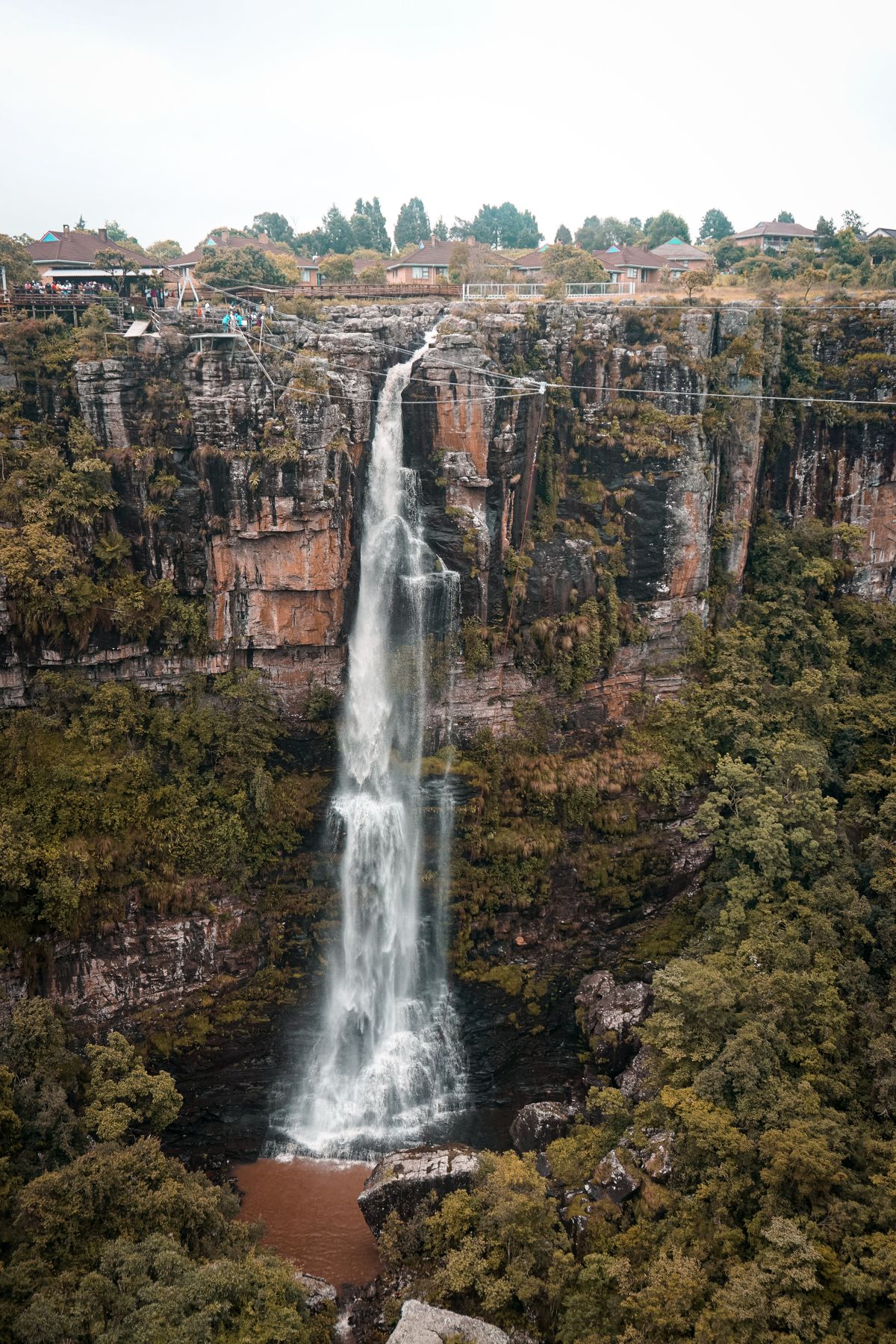
Lisbon Falls and Berlin Falls: Two of the tallest waterfalls on the route. Lisbon Falls drops 92 metres into a semi-circular amphitheatre. Berlin Falls is narrower but equally dramatic, plunging 80 metres from a horseshoe-shaped ledge. Both are easily accessible from the road with short walks from the car park.
Mac Mac Falls: Slightly further along the route, this is a dramatic twin cascade dropping into a deep forested gorge. There’s a viewing platform at the top with a great angle, though the fence can make photography tricky. The nearby Mac Mac Pools are a gentler alternative if you want a picnic spot or a paddle.
The Caves: More Than Just a Scenic Drive
Pilgrim’s Rest: An entire gold-rush town preserved as a living museum. Gold was discovered here in 1873, and for a few chaotic years, it was one of the richest towns in the Transvaal. Today the buildings are original, the cemetery on the hill tells its own stories, and the Royal Hotel will let you sleep in a room that looks much as it did a century ago. It’s touristy, yes, but it’s also genuinely evocative. Spend an hour walking the single street.
Sudwala Caves: An ancient limestone cave system with impressive chambers and rock formations. Guided tours take you through enormous chambers with names like the P.R. Owen Hall and the Fairyland Formation. The caves were used as shelter by prehistoric humans and more recently as a hideout during the South African War. Bring a jacket , it’s 17 degrees underground year-round.
How to Plan Your Day
Direction matters. Most travellers drive the route from west to east (Sabie toward Graskop and Hoedspruit), ending up at Kruger. Choose your direction around your overnight stops and Kruger entry gate, and use designated parking areas at viewpoints.
Start early. Aim to leave Sabie or Hazyview by 7 AM. Cloud often builds over the escarpment from late morning, and by mid-afternoon God’s Window and the Three Rondavels can be socked in. The earlier you hit the viewpoints, the clearer and quieter they’ll be.
Allow a full day. Don’t try to combine the Panorama Route with a Kruger game drive on the same day. You’ll rush both. Allow a full day for a selection of the main stops. Adding Sudwala Caves, Pilgrim’s Rest and longer walks may require a second day.
Where to eat: Graskop has several roadside restaurants and the famous Harrie’s Pancakes, which has become something of an institution along the route. The sweet and savoury Dutch-style pancakes are genuinely good and the portions are generous. If you want something quieter, pack a picnic and eat at Mac Mac Pools or the Lisbon Falls picnic area.
Practical Tips for October
October can be a good time for the Panorama Route as the region moves into its wetter season. Rainfall timing, waterfall flow and visibility vary from year to year and from day to day. Check a local forecast before you travel, carry a light jacket and leave room to adjust your route if mist or storms obscure the viewpoints.
Driving conditions: The roads along the route are tarred and generally in good condition, but they are winding and narrow in places. Drive carefully, especially around God’s Window and the Three Rondavels where tour buses and minibuses stop frequently. If you’re self-driving, a standard sedan is fine , you don’t need a 4×4.
What to bring: A light jacket or fleece for mornings, sunscreen, water, a camera with a wide-angle lens for the canyon views, and cash for the small entrance fees at Bourke’s Luck Potholes and the waterfalls. There is signal in the towns but it drops out in the gorges.
The Panorama Route Is Not an Add-On. It’s a Destination.
Too many travellers treat the Panorama Route as a drive-through between Johannesburg and Kruger. That’s a mistake. This is some of the most varied scenery in Southern Africa , waterfall, canyon, cave, forest, historic town and endless viewpoint, all within a few hours of driving.
Whether you’re on your first trip to Southern Africa or your fifth, make room for a day on the escarpment. The Big Five are unforgettable. But standing at the edge of the Blyde River Canyon at dawn, with the lowveld stretching green and infinite below you, is the image that will stay with you longer.
An October visit can be memorable. Keep your plans flexible and let the weather help you choose your stops.




The editorial team at Destination Southern Africa brings you the most comprehensive travel intelligence for Southern Africa. With decades of combined experience in African tourism, we cover everything from hidden gems to practical travel tips for international visitors.